Security in every line, so you can code without compromise

AURI gives AI coding agents the context they need to write secure code, wherever they work.
Code Generation
Guides AI agents to write secure code from the start with real-time vulnerability intelligence.
Code Review
Finds risks across code, dependencies, and architecture and validates what's reachable and exploitable.
Backlog Reduction
Delivers accurate, context-aware fixes based on your codebase, not generic suggestions.

Introducing , security for agentic software development

AURI helps teams build smarter, faster, and safer by embracing agentic software development. It combines agentic reasoning and deterministic program analysis, so every finding comes with the evidence to act and the confidence to fix.
10x
fewer security tickets
83%
fewer blocked PRs
6X
faster fixes
As a fast-growing AI company, we prioritize feature velocity without compromising security. Endor Labs’ unique reachability-based analysis and native integrations into our AI-native software development stack keep our developers focused on rapidly finding and fixing real risks in the SDLC, so we ship faster with confidence.”
Sunil Agrawal Photo
Sunil Agrawal
CISO, Glean
Deep code reasoning
AURI uses multi-modal detection combining agentic reasoning and deterministic program analysis tools to catch complex logic flaws and classic vulnerabilities, all in a unified engine.
Detect changes to security architecture
Multi-file, multi-function data flow
Source-to-sink taint analysis
Custom organizational context
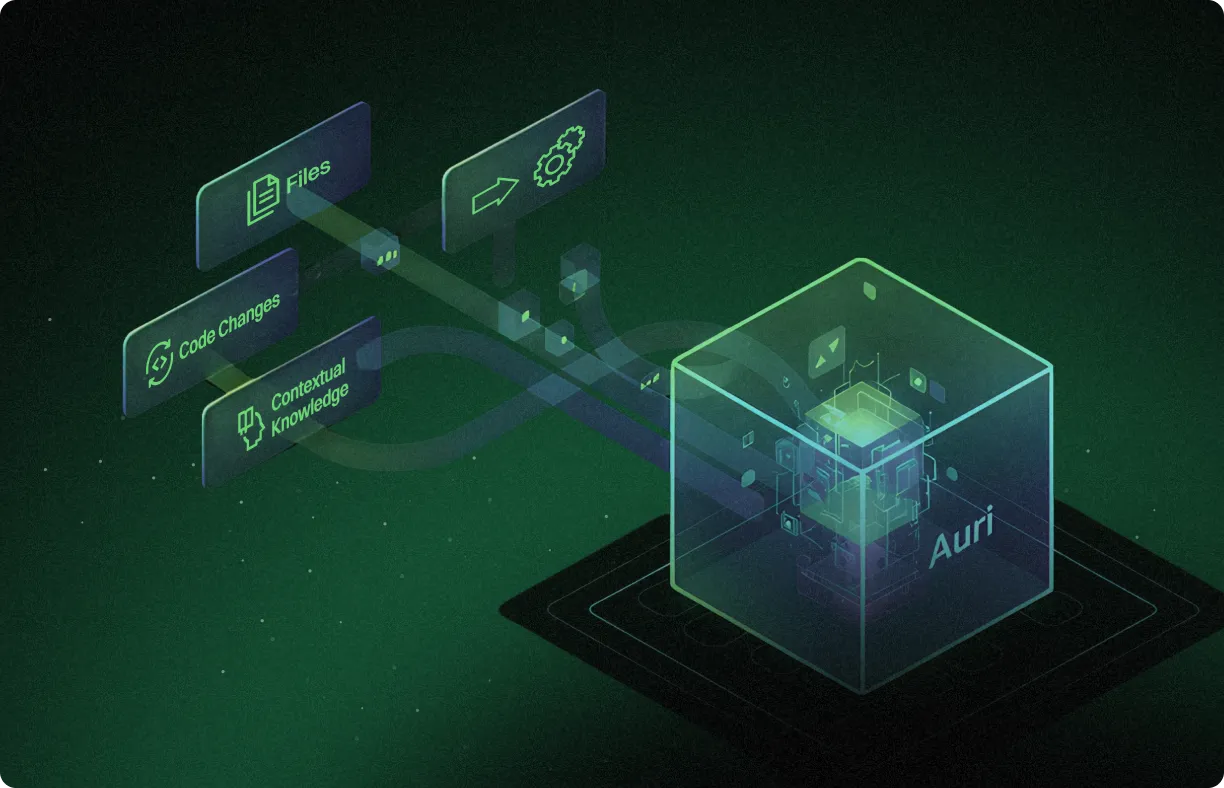
Digital illustration showing streams of data labeled Files, Code Changes, and Contextual Knowledge flowing into a translucent cube labeled Auri.
Three layered transparent panels labeled Base Image, OS Dependencies, and Application stacked diagonally on a dark green background.
Full-stack reachability
Trace reachability and determine exploitability across code, direct and transitive dependencies, and container images.
Reduce noise up to 95% in every layer
Identify which vulnerabilities are reachable and exploitable
Get transparent evidence showing data flow and call paths
Reduce costs for FedRAMP, PCI CSS, CRA, and more
Agentic remediation
Don’t wait to open a PR. AURI continuously validates and fixes code as developers and agents work, keeping releases shipping while ensuring code is secure by default.
Surfaces high-impact fixes
Identifies the safest upgrade path
Detects breaking changes
Performs fixes and refactors code
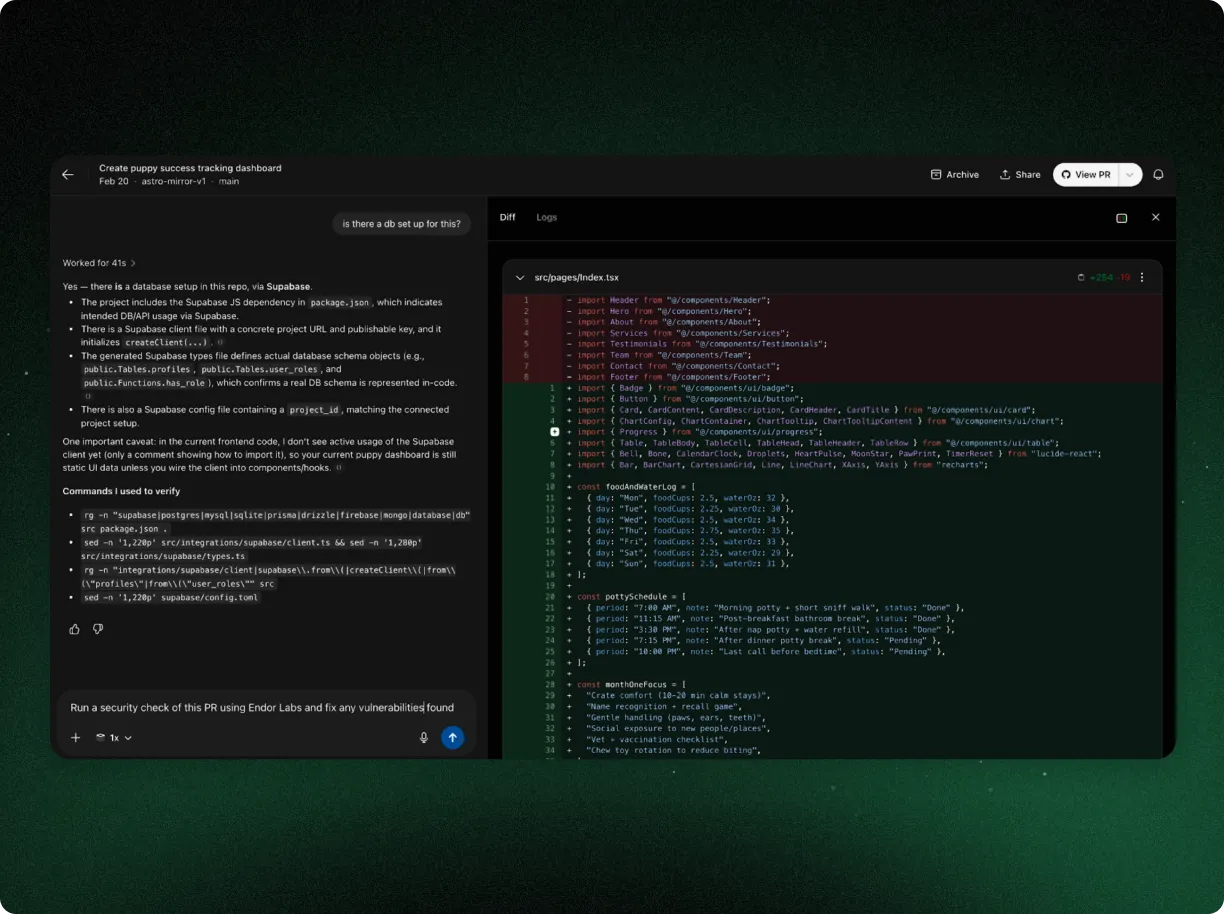
Screen showing a dark-themed code review dashboard with a conversation about Supabase database setup and source code for a TypeScript file.

How it works

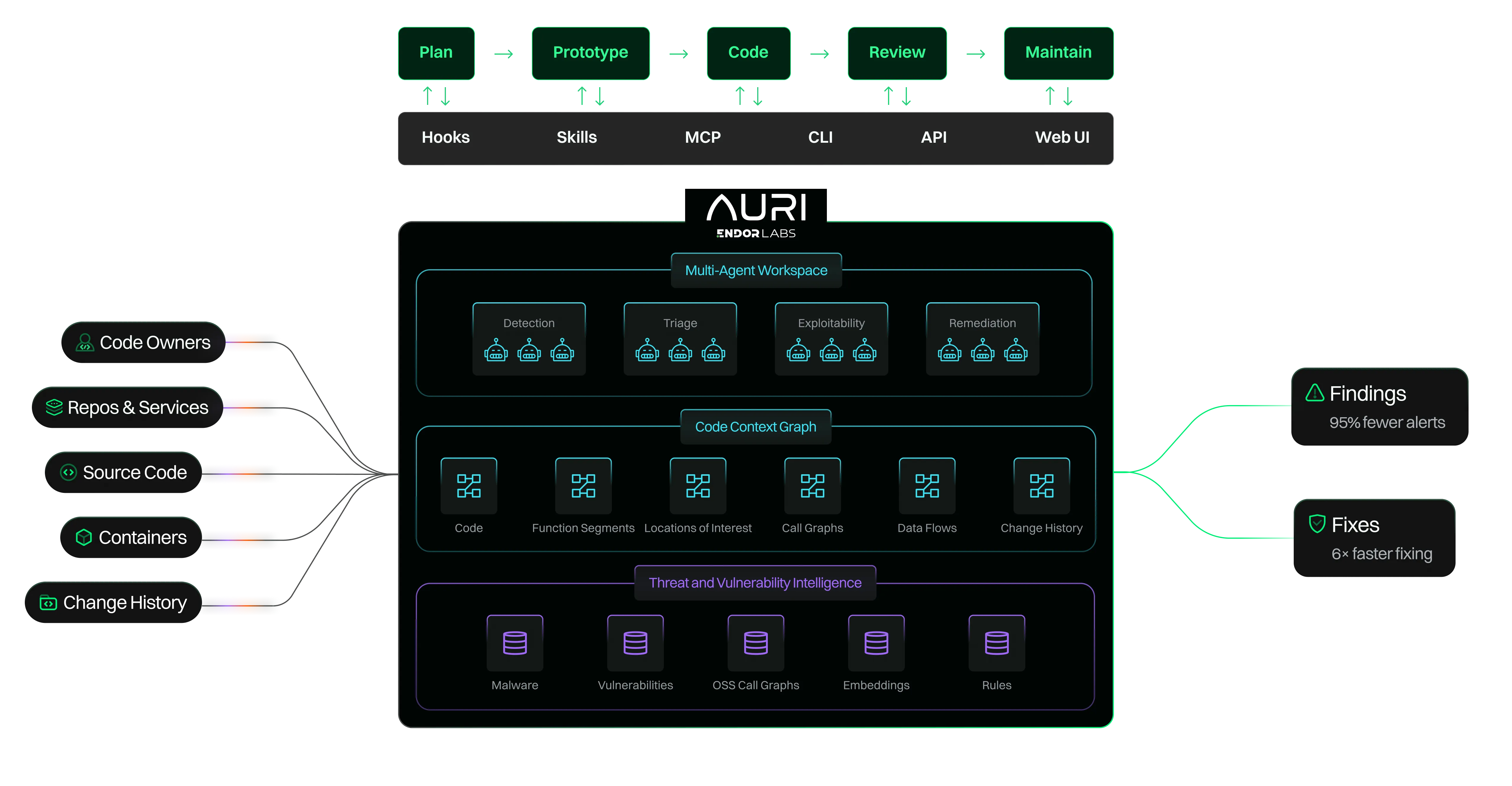
AURI gives AI coding agents security context wherever they work — in the IDE, CI pipeline, or the cloud. It gives agents the tools they need to find vulnerabilities, validate if they’re exploitable, and fix them. All inside your existing development workflows.
Diagram of AURI's software development workflow with inputs from Code Owners, Repos, Source Code, Containers, and Change History feeding into a multi-agent workspace for detection, triage, exploitability, and remediation. The workspace includes a code context graph of code, function segments, locations of interest, call graphs, data flows, and change history, supported by threat intelligence databases for malware, vulnerabilities, OSS call graphs, embeddings, and rules, resulting in findings with 95% fewer alerts and fixes with 6x faster resolution.
Meets you wherever you work
AURI integrates wherever you work: in AI code editors, code review, CI, or even within autonomous cloud agents.
Integrates via Hooks, Skills, MCP, or CLI
Checks for vulnerabilities after the agent makes edits
Covers code, secrets, dependencies, and container images
Workflow diagram showing stages Plan, Prototype, Code, Review, Maintain linked by arrows, with related components Hooks, Skills, MCP, CLI, API, and Web UI below.
Diagram of a Multi-Agent Workspace divided into four sections: Detection, Triage, Exploitability, and Remediation, each with three robot icons.
Uses purpose-built security agents
AURI uses multiple agents and sub-agents to detect risks, evaluate exploitability, triage findings, and perform remediation.
Fully transparent findings show reasoning
Merge-ready fixes with evidence
Support for 40+ languages and frameworks
Powered by the code context graph
AURI is powered by the code context graph, a deep representation of how your application works. It’s powered by custom tools that help agents understand semantic meaning, dataflow, and reachability.
Code owners and teams
Systems (repos, services)
Change history (commits, PRs, builds, deploys)
Files, functions, and classes
Diagram titled Code Context Graph showing six interconnected icons labeled Code, Function Segments, Locations of Interest, Call Graphs, Data Flows, and Change History.

Unmatched code security intelligence

LLMs are trained on unlabeled code from open-source software. They inherit the good and bad, including vulnerabilities. AURI leverages the industry’s most extensive security knowledge base of open source packages, AI models, vulnerabilities, and code relationships to turn unlabeled open source code into unique security insights.
1Billion
Risk Factors
Evaluates open source libraries and AI models against 150+ risk factors covering security, activity, and operational risks.
2T
OSS Lines Analyzed
Analyzes every code diff that introduced avulnerability (CVE), the associated flaws (CWEs), and the patch that fixed it.
7M
Weekly Code Scans
Scans millions of projects every week to generate embeddings, mapping semantic meaning and understanding changes.
Flowchart showing integration paths from GitHub, GitLab, and PHP to Slack and Microsoft platforms, with a C# icon connected to Slack.

Your Tools, Your Languages
All Secured

Lean how Endor Labs fits into your ecosystem.
Flow diagram connecting software development tools and platforms including .NET, JetBrains, GitHub, Google, and Vercel.
G2 logo

Endor Labs greatly reduced our CVE backlog, which helps satisfy the near zero tolerance for vulnerabilities often seen in highly regulated markets."

Joshua Domagalski
Joshua Domagalski
CISO, Astronomer

We have been pleasantly surprised about the lack of friction when trying new features outside, like container scanning, that are outside the traditional SCA scope. It took us just five minutes to set up a CircleCI job and give it a container from our registry, and we were immediately seeing results."

Josiah Bruner
Josiah Bruner
Sr Security Engineer, Jellyfish

Endor Labs reduced our SCA alerts by 76%, which let us give back 11,424 development hours.”

Greg Pettengill
Greg Pettengill
Principal Product Security Engineer, Five9

Our collaboration with Endor Labs makes Defender for Cloud the first CNAPP to provide true code-to-runtime reachability."

Vlad Korsunsky
Vlad Korsunsky
Corporate Vice President, Cloud & Enterprise Security at Microsoft

Implementing Endor Labs is easy. I had exactly what I needed between the docs, CLI tool, a GitHub Action, and a GitHub app— all readily available."

Alex Olea
Alex Olea
DevSecOps Engineer, Starburst

Endor Labs is, in a good way, simplistic. The data I care about is quickly available to me."

James Kirk
James Kirk
Head of Security and Privacy, Jellyfish

Software analysis is hard, and there's only one company [Endor Labs] that's doing it correctly.”

Paul Padilla
Paul Padilla
Head of Software and Infrastructure Security, Mysten Labs

Endor Labs delivered on its promise to make SCA way more efficient and bubble up what actually matters much quicker."
Idan Fast
Idan Fast
Co-Founder & CTO, Grip Security

Having something that was able to say, ‘We’re only focusing on things that are reachable, and we’re able to provide proof that it is reachable,’ was a huge win with the engineering team because they knew we were actually focused on solving real problems."

Joshua Domagalski
Joshua Domagalski
CISO, Astronomer

My team is responsible for remediating vulnerabilities. Endor helps us do it quickly so we can deliver the most secure AI product possible.”

Travis McPeak
Travis McPeak
Security, Cursor (Anysphere)

Endor Labs is like noise canceling headphones for vulnerability management and AppSec. We're able to focus only on the signal and avoid the noise. Our engineering team stays focused on shipping great products, security focuses on mitigating risk, and the company is focused on being a profitable company.”

Joshua Domagalski
Joshua Domagalski
CISO, Astronomer

Endor Labs is helping us adapt our application security program to address emerging risks from generative AI while using AI to scale and enhance its effectiveness.”

Greg Pettengill
Greg Pettengill
Principal Product Security Engineer, Five9

One of the main reasons we increased investment in Endor Labs was the additional telemetry for fix requirements. It allows us to further prioritize work, for example we can schedule a larger fix with many breaking changes for a later sprint while getting the easier ones done quickly."

Joshua Domagalski
Joshua Domagalski
CISO, Astronomer

FAQs

What is AURI?

AURI by Endor Labs is an AI-native application security platform built for agentic software development. It equips security agents with the tools, skills, and context they need to find vulnerabilities, validate they're real, and fix them — all within your existing development workflows. At its core is a code context graph that maps how your code, dependencies, container images, and services actually connect.

How is AURI different from traditional application security tools?

Traditional AppSec tools — SAST scanners, SCA tools, and vulnerability management platforms — flag alerts without understanding your application's actual architecture. They can't tell whether a vulnerability is reachable, whether upstream middleware already mitigates a finding, or what a valid fix looks like in your specific codebase. AURI’s proprietary code context graph combines deep program analysis, proprietary threat intelligence, and agentic AI reasoning to deliver evidence-backed findings instead of alert noise, and can autonomously remediate the issues it finds.

How does AURI work with AI coding agents?

AI coding agents can write code, but lack security context — they can't see how your full application connects. AURI provides the missing security intelligence layer. It monitors code generated by AI agents, validates it against your application's architecture, catches vulnerabilities that single-file analysis would miss, and works directly with your coding agent to apply fixes. Think of AURI as the security intelligence your AI coding agent is missing.

What languages, frameworks, and tools does AURI support?

AURI integrates with popular IDEs and coding tools including Cursor, Windsurf, VS Code, and Claude Code via MCP, Skills, and CLI. It plugs into your CI/CD pipeline via API and supports analysis across first-party code, open-source dependencies, and container images. For specific language and framework support details, contact our team or check the documentation.

Can AURI automatically fix vulnerabilities?

Yes. AURI's autonomous remediation capability goes beyond flagging issues. When it identifies a real vulnerability, it already understands where the affected code is used, whether the vulnerable paths are reachable, and what a valid fix looks like in your specific codebase. It works directly with your coding agent to apply patches and refactor code to avoid breaking changes — without pulling developers off feature work.

How does AURI detect malicious open-source packages?

AURI uses an LLM-native malicious package detection pipeline that analyzes package behavior the way a senior security researcher would — examining install scripts, obfuscation patterns, network calls, and data exfiltration signals in context. Unlike traditional YARA rule-based detection, which suffers from high false positive rates, AURI can scan and analyze any OSS package within two minutes at 99% accuracy. It catches threats like typosquatting, dependency confusion, and obfuscated exfiltration scripts before your agent ever imports them.

What is the code context graph?

The code context graph is AURI's foundational technology. It's a deep representation of how your application actually works — mapping first-party code, open-source dependencies, container images, and data flows into a unified model. It's powered by purpose-built program analysis tools (call graph analysis, data flow analysis, code summarization, and code navigation) combined with proprietary vulnerability and threat intelligence at the function level. This graph is what allows AURI to reason about your application with the same depth as a senior security engineer.

Is AURI free for individual developers?

Yes. AURI's MCP, Skills, and CLI are free for developers to install and start using immediately. You can add AURI to your editor in minutes and start writing more secure code. For enterprise teams that need AURI's full platform — including organization-wide policies, governance, and integrations — contact us to book a demo.

How does AURI help reduce security backlogs?

Most security backlogs grow because teams can't distinguish real risk from scanner noise, and fixing requires manual developer context-switching. AURI attacks this from both sides: it eliminates up to 95% of false positives so your backlog only contains real issues, and its autonomous remediation applies validated fixes inside your existing workflows. Teams can burn down backlogs that have been growing for years without pulling developers off feature work.

Start shipping with confidence